

For many aircraft owners and operators, the Airworthiness Review Certificate (ARC) renewal is perceived as an administrative milestone. In reality, it is a critical regulatory process that directly impacts the aircraft’s ability to continue flying legally and safely.
Lack of anticipation of an ARC renewal can rapidly lead to operational disruption, aircraft grounding, scheduling pressure, and unnecessary costs. On the other hand, a properly planned airworthiness review allows findings to be addressed calmly and efficiently, while maintaining operational continuity.
This article aims to clarify how the EASA ARC renewal process works, why anticipation is essential, and how operators can avoid common pitfalls.
What Is an ARC?
Under EASA – European Union Aviation Safety Agency regulations, an Airworthiness Review Certificate (ARC) confirms that an aircraft remains compliant with its approved type design and continuing airworthiness requirements. The ARC is linked to the aircraft’s continuing airworthiness status and maintenance oversight. Without a valid ARC, an aircraft cannot legally operate.
The ARC can be compared to the mandatory roadworthiness inspection required for cars in Europe, following a similar principle of periodic compliance and condition verification.
ARC Validity – Controlled vs Non-Controlled Environment
One of the most misunderstood aspects of ARC management concerns the validity period.
Aircraft in Controlled Environment
When an aircraft is maintained within a controlled environment:
- Continuing airworthiness managed by an approved Part-CAMO
- Maintenance performed by an approved EASA Part-145 organisation
…the ARC may remain valid for up to 3 years through:
- Initial ARC issuance
- Two consecutive ARC extensions, provided that the conditions of controlled environment are maintained.
Aircraft NOT in Controlled Environment
For aircraft outside controlled environment, the ARC must undergo a full renewal every year and a complete airworthiness review is required annually. This distinction has major operational and planning implications for operators.
Who Can Perform an Airworthiness Review?
The airworthiness review (AR) required for ARC renewal must be performed by an approved EASA Part-CAMO organisation holding Subpart I privileges.
More importantly, the review itself must be carried out by specifically approved personnel known as Airworthiness Review Staff (ARS).
These individuals are:
- Formally accepted by the competent authority
- Required to demonstrate specific and recent qualifications and experience
- Required to remain independent from the continuing airworthiness management and maintenance activities performed on the aircraft under review
This independence is essential to ensure an objective and unbiased compliance assessment.
What Does the Airworthiness Review Include?
An airworthiness review is far more than a simple paperwork check. It includes two major parts:
1. Documented Review of Continuing Airworthiness Records
This includes verification of:
- Aircraft status
- Airworthiness Directives (AD) compliance
- Maintenance programm compliance
- Component status
- Life-limited parts
- Repairs and modifications
- Deferred defects
- Operational Manuals
- Flight hours and cycles tracking
- Flight Manual
- Weight & balance records
- Technical log continuity
- Certificates and mandatory onboard documentation
2. Physical Survey of the Aircraft
The aircraft itself is physically inspected to verify:
- General condition
- Configuration conformity
- Markings and placards
- Equipment installation
- Obvious defects or inconsistencies
- Correlation between physical aircraft and records
The objective is to confirm both the technical condition and regulatory compliance of the aircraft.
The Ideal ARC Renewal Timeline
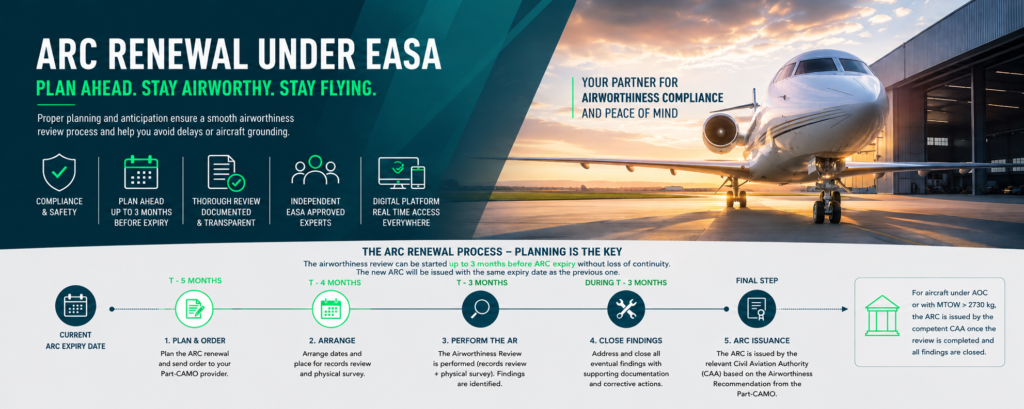
One of the key advantages under EASA regulations is that the airworthiness review can be initiated up to 3 months before ARC expiry without losing continuity.
This means the new ARC validity period will continue from the previous expiry date when the Airworthiness Review is performed during the 3 months prior the expiry date without prejudice. This provides valuable flexibility for operators to navigate through this process.
Recommended Planning Chronology
T – 5 Months – Plan the ARC renewal
- Select and contract the Part-CAMO
- Issue purchase order / work order
- Define scope and aircraft availability
T – 4 Months – Arrange logistics
- Schedule dates for: Records review & Aircraft physical survey
- Confirm aircraft location
- Ensure record accessibility
T – 3 Months – Perform the Airworthiness Review
- Detailed records review
- Physical aircraft survey
- Identification of eventual findings
During the T – 3 Months Window – Correct findings
This phase is critical since it is mandatory that all findings are closed in order to complete the review. Some findings may require:
- Additional maintenance
- Missing documentation reconstruction
- OEM support
- Part-145 intervention
- Engineering assessment
- Regulatory clarification from CAA, EASA or OEM
Without sufficient anticipation, these items can rapidly become schedule drivers.
Final Step – ARC issuance
Once the review is completed, the Part-CAMO will renew the ARC with a validity for 12 months. In some specific conditions, the ARC itself is issued by the competent Civil Aviation Authority (CAA), based on the Airworthiness Recommendation issued by the contracted Part-CAMO after successful completion of the review. This apply to aircraft commercialy operated under AOC or aircraft above 2730 kg MTOW.
Why Operators Should Never Wait Until the Last Minute
In practice, many ARC delays are not caused by the review itself, but by unresolved findings discovered too late.
Typical examples include:
- Missing maintenance records
- Incomplete modification status
- Incorrect component tracking
- Expired equipment certifications
- Unrecorded repairs
- Inconsistent flight time reporting
- Outstanding Airworthiness Directives
Some corrective actions may require several weeks to resolve.
If the aircraft reaches ARC expiry before closure of findings, operations may stop until compliance is restored.
Documentation Matters More Than Ever
Under EASA requirements, the entire review process must be properly documented.
This includes evidence of:
- Reviewed records
- Surveyed statuses
- Compliance assessments
- Physical aircraft inspection
- Findings and corrective actions
Modern airworthiness reviews increasingly rely on strong traceability and detailed evidence retention.
At NORDIC AVIATION CAMO & CONSULTING, our airworthiness reviews are extensively documented with photographs of both aircraft condition and maintenance records. Depending on aircraft complexity, a typical review may generate between 200 and 600 documented pictures.
This level of documentation provides:
- Enhanced traceability
- Stronger compliance evidence
- Improved transparency for operators
- Better support during authority oversight or future transitions
Our Approach – Digitalisation of the Airworthiness Review Process
Efficient communication and transparency are essential during an airworthiness review, especially when findings, records, corrective actions, and operational constraints must be coordinated between multiple stakeholders.
To streamline this process, NORDIC AVIATION CAMO & CONSULTING uses an innovative dedicated digital online platform allowing operators and CAMO representatives to follow the airworthiness review process in real time.
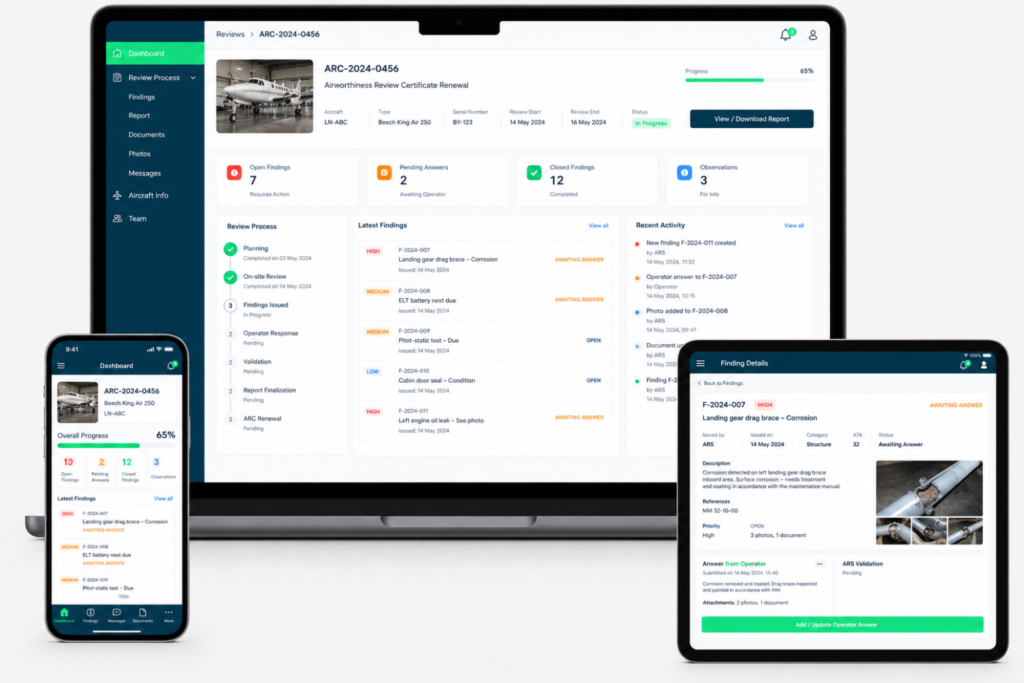
Through this platform, customers can:
- Monitor the review progress live
- Access the airworthiness review report in real time
- Receive findings immediately as they are identified and view supporting documentation and pictures taken by the Airworthiness Review Staff (ARS)
- Allocate findings to proper stakeholder for improved coordination
- Upload corrective action evidence and supporting documents directly into the system
- Exchange comments and answers with the reviewing ARS and CAMO team
This collaborative platform significantly improves communication efficiency and reduces delays caused by fragmented email exchanges or missing information.
The platform also provides:
- Clear visual management of open and closed findings
- Real-time tracking of review progression
- Better traceability of corrective actions
- Faster coordination between operator, CAMO, maintenance organisations, and authorities
- Fully auditable process
Accessible from laptop, tablet, or smartphone, the system allows all involved parties to stay connected to the review process everywhere and at any time.
The result is a smoother, faster, and more transparent ARC renewal experience for operators and aircraft owners.
Final Thoughts
A smooth and successful ARC renewal is never about luck. It is the result of:
- Proper anticipation
- Strong record management
- Transparent communication
- Structured continuing airworthiness oversight
Operators who plan early significantly reduce operational risk, avoid unnecessary pressure, and ensure smoother interactions with maintenance organisations and authorities.
ARC renewal should not be treated as a last-minute administrative exercise. It is a strategic component of safe and compliant aircraft operation.
At NORDIC AVIATION CAMO & CONSULTING, we strongly encourage operators to begin planning their airworthiness review several months before expiry to ensure a smooth, efficient, and disruption-free renewal process.
Book your Airworthiness Review with us today and secure you slot at : Plan Your Next ARC Renewal !